
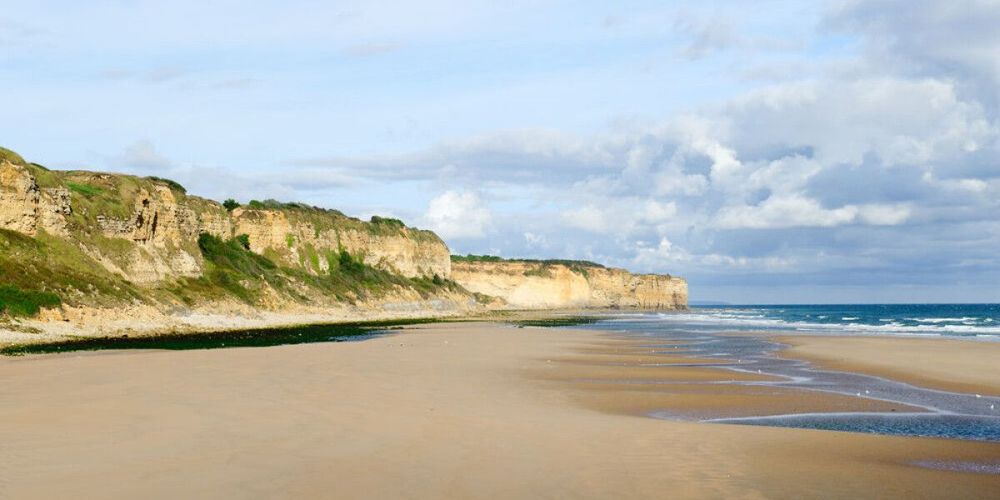
UNESCO World Heritage status intensifies scrutiny of Normandy wind farm project
The inscription of Normandy's D-Day landing beaches on the UNESCO World Heritage List on July 26, 2026, at a committee meeting in Busan, South Korea, has brought renewed attention to a controversial offshore wind farm under construction off the Calvados coast.
The 64-turbine project being built near Courseulles-sur-Mer now faces intensified opposition from heritage conservation groups, who argue the installation conflicts with the newly recognized status of the beaches where more than 150,000 Allied troops came ashore on June 6, 1944, in what remains the largest amphibious invasion in history.
UNESCO advisory body flags wind farms as threat
The controversy gained additional weight when ICOMOS (International Council on Monuments and Sites), which evaluates submissions to the UNESCO heritage committee, specifically cited wind farms near the D-Day beaches as one of several potential threats requiring stronger monitoring and preservation efforts during the World Heritage evaluation process.
The beaches granted World Heritage status include Utah Beach, Omaha Beach, Gold Beach, Sword Beach, Pointe du Hoc and Juno Beach. Juno Beach, off Courseulles-sur-Mer, will have the closest view of the turbines, located approximately 10 kilometers offshore.
Jean-Louis Butré, president of the Fédération Environnement Durable, said the UNESCO listing strengthens objections his organization and local groups have raised for over a decade.
The D-Day landing beaches are sacred places. We cannot ask UNESCO to help protect world heritage while at the same time allowing projects that, in our view, alter these landscapes.
Butré's federation has called on the government to suspend construction, arguing the turbines will fundamentally change the experience for visitors to these sites of remembrance.
When people visit the beaches, it is first and foremost a place of remembrance. They come to remember the sacrifice of American, Canadian, British, Australian and other Allied soldiers who came to help liberate Europe. You will have wind turbines flashing in front of you. It changes the atmosphere of a historic site.
Long-standing project proceeds despite opposition
The Courseulles-sur-Mer offshore wind farm was awarded to a consortium including EDF Renewables and Enbridge through the French government's first offshore wind tender in 2012. Construction formally began in February 2021 following the finalization of financing agreements for the €2 billion project.
EDF Power Solutions, a partner in the turbine project, firmly rejects any conflict with the site's historical significance.
EDF welcomes the inscription of the beaches on the UNESCO World Heritage list. The teams working on the project have fully taken into account the memory of the D-Day landings.
The company emphasized this approach was developed following commitments made after a public debate on the project more than 10 years ago. A dedicated "History and Duty of Remembrance" group was created, bringing together historians, veterans' organizations, museums and other representatives involved in preserving World War Two heritage. As part of this initiative, the 64 turbines will be named after ships that took part in the D-Day landings and the Battle of Normandy.
The spokesman added that
the existence of the offshore wind farm was taken into account and included in the report of the UNESCO inspector evaluating the site.
Part of broader offshore expansion
The Calvados installation follows the Fécamp offshore wind farm further east, which became fully operational in 2024 with 71 turbines generating approximately 500 megawatts, making it the first major offshore wind farm completed in Normandy. A third facility is under construction at Dieppe.
The Calvados wind farm will have a total capacity of around 450 megawatts, producing the equivalent of the domestic electricity consumption of more than 630,000 people—exceeding 90 percent of the Calvados department's population. The turbines will occupy an area of approximately 50 square kilometers, with the seabed footprint representing less than one percent of this zone, according to EDF.
A specialized operations and maintenance base at Caen-Ouistreham, inaugurated in April 2023, will support the facility. The company predicts more than 1,000 jobs during construction and around 100 permanent positions linked to the maintenance operations.
The project forms part of France's ambitious offshore wind expansion. With only 2.26 gigawatts of installed offshore wind capacity as of the first quarter of 2026, the government faces a substantial challenge to reach its target of 15 gigawatts by 2035. In June 2026, France launched a massive tender process for 10 gigawatts of new offshore wind capacity, comprising seven floating and four fixed-bottom wind farms, representing one of the largest offshore wind procurement initiatives in European history.
Global precedent for heritage conflicts
The Normandy situation reflects a broader challenge facing renewable energy development near cultural sites. UNESCO released specific guidance in March 2023 titled "Guidance for Wind Energy Projects in a World Heritage Context" to address such conflicts, recognizing they are becoming increasingly common worldwide.
Previous conflicts between UNESCO World Heritage sites and wind farms have occurred at multiple European locations, including Germany's Wartburg Castle and Sweden's Öland Island, where UNESCO warned that wind turbines could destroy the justification for World Heritage status.
UNESCO's recommendation regarding the Calvados wind farm states it should be dismantled at the end of its concession in 2057, with the site restored to its original condition. However, this represents guidance rather than a legal order to halt construction or remove the turbines.
Environmental concerns raised by Butré extend beyond visual impact, encompassing potential effects from seabed foundation construction on marine life and bird populations.
Despite the UNESCO recognition marking the culmination of a project launched nearly two decades ago and continued opposition from several associations, the wind farm project continues to move forward as France pursues its renewable energy objectives.