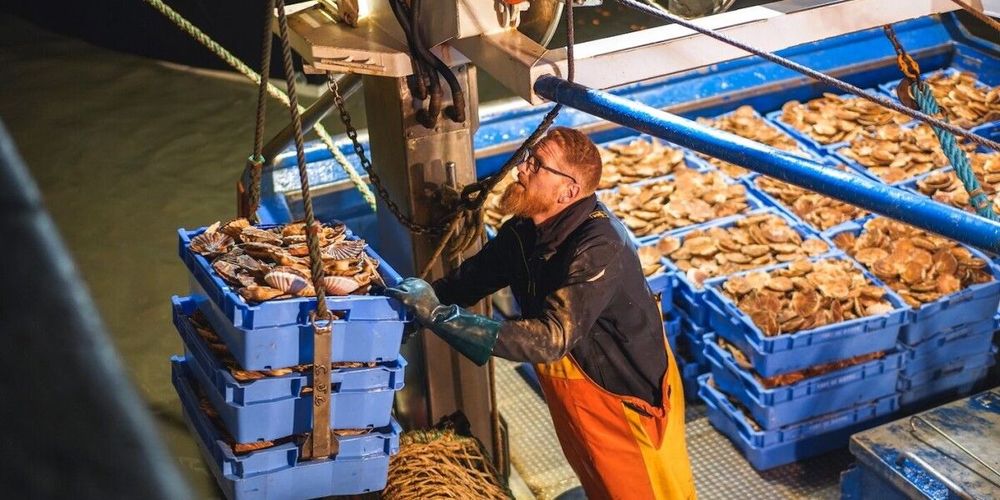
Bay of Seine scallop harvest sets European record amid sustainability efforts
Fishermen working the waters between Pointe de la Hève in Seine-Maritime and Pointe de Barfleur in the Manche département have achieved an unprecedented harvest, pulling in more than 100,000 tonnes of king scallops during the 2025-2026 season. The haul represents five times the typical annual catch and establishes the Bay of Seine as Europe's most productive scallop fishery.
Studies conducted by Ifremer, the French Research Institute for Exploitation of the Sea, documented the exceptional results. The success reflects decades of careful management, with scallop populations in Normandy increasing twentyfold over the past two decades. France accounts for 91% of all scallop production within the European Union, and the king scallop stands as the country's most valuable commercial marine species.
Strict management drives population recovery
The remarkable growth in scallop stocks stems from rigorous self-imposed regulations adopted by Normandy fishermen. Chief among these measures is an annual moratorium designating 25% of the Bay of Seine as off-limits to harvesting, allowing populations to regenerate undisturbed.
A rotational fallow system implemented in November 2016 has proven particularly effective, tripling the biomass of king scallops in the bay. France further controls the fishery through a seven-month fishing window that runs from October 1 each year, giving scallops time to reproduce during the remaining months. Daily quotas limit vessels to 1.5 to 2 tonnes depending on boat size, while regulations require harvested scallops to measure at least 105 millimeters.
These conservation efforts earned the Bay of Seine fishery "Sustainable Fisheries" certification from the Marine Stewardship Council in December 2025. The industry operates approximately 800 vessels and provides employment for nearly 3,000 fishermen. Demand remains strong, particularly during the Christmas season when scallops traditionally appear as starters in holiday meals.
Climate change emerges as key threat
Despite current abundance, marine biologists express concern about climate change impacts on future scallop populations. Éric Foucher, a research biologist at Ifremer, noted that average English Channel temperatures have climbed 1.5 degrees Celsius over three decades. Sea surface temperatures in the Western English Channel are rising at rates between 0.23 and 0.32 degrees per decade, with more pronounced warming occurring in offshore waters.
The warming trend is already altering scallop reproductive patterns. Spawning now occurs in March rather than May, a shift of two months earlier in the year. Scientists have also observed that individual scallops are becoming progressively smaller.
Ifremer emphasized the need for continued vigilance despite currently high harvestable biomass levels. Natural population fluctuations combined with accelerating climate effects could challenge the sustainability measures that have proven successful to date. The scientific community continues monitoring the Pecten maximus populations to detect any concerning trends that might require adjustments to management practices.