
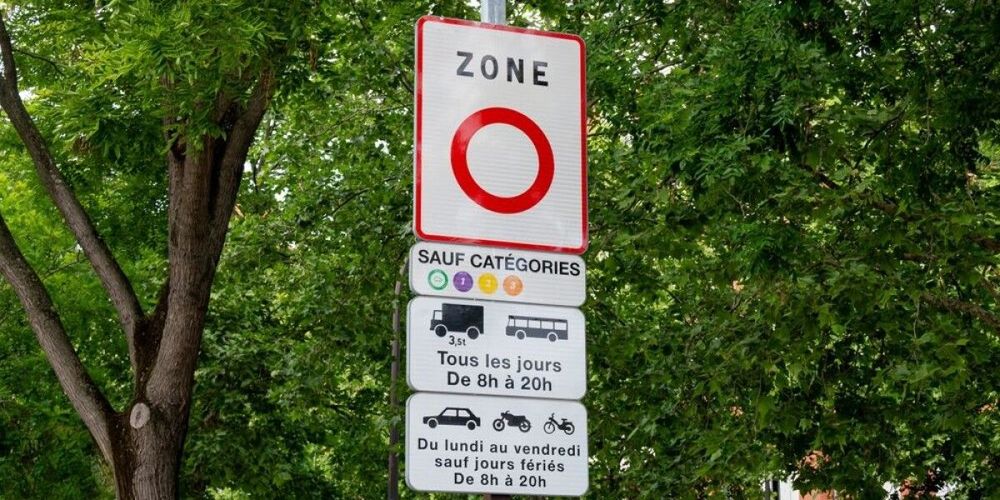
France's low-emission zones: understanding the rules and measuring the impact
France's low-emission zones (zones à faibles émissions, or ZFEs) continue to operate across the country, though what drivers can and cannot do varies significantly depending on location. The zones restrict access based on vehicles' Crit'Air emissions ratings, aiming to reduce urban air pollution in areas where concentrations have regularly exceeded EU legal limits of 40 µg/m³ for nitrogen dioxide and 10 µg/m³ for PM2.5 particles.
The system was established through the 2019 Mobility Orientation Law and expanded under the 2021 Climate and Resilience Law, which requires towns and cities with populations above 150,000 to designate low-emission mobility zones. However, the legal status of ZFEs faced uncertainty earlier this year when Parliament voted to abolish them in April 2026. The Constitutional Council reinstated the zones in May 2026, ruling the abolition clause was a legislative rider improperly inserted into an economic simplification bill.
The backdrop to these measures includes serious regulatory pressure. In 2019, the European Court of Justice ruled that France had systematically and persistently exceeded nitrogen dioxide pollution limits since 2010 in twelve zones. The French government was subsequently fined multiple times, including three €10 million penalties in 2021-2022 by France's Conseil d'État for failing to address the problem.
How the system works
ZFEs operate by restricting circulation of the most polluting vehicles. The Crit'Air sticker classifies vehicles according to fuel type, European emissions standard and vehicle category. Electric and hydrogen vehicles receive Crit'Air 0 classification, while the oldest and most polluting vehicles are rated Crit'Air 5 or remain unclassified.
The strictest rules apply in areas with the worst pollution records. Paris and Lyon currently face the most stringent national requirements. Other cities have greater flexibility over which vehicles they restrict. In Dijon, all vehicles, including Crit'Air 5 cars, can currently circulate in the ZFE. Reims has restrictions on Crit'Air 5 and 4 vehicles but has delayed restrictions on Crit'Air 3 vehicles until January 2029 under a five-year moratorium.
Rules also vary by vehicle type, with restrictions on passenger cars, light commercial vehicles and heavy vehicles potentially applying at different times. Some cities offer ZFE Pass exemptions allowing limited circulation regardless of Crit'Air rating—12 days per year in Grenoble, 24 days in Paris, and 52 days in Lyon and Montpellier.
Drivers must obtain the official Crit'Air sticker to enter a ZFE. The sticker costs €3.11 plus postage, typically totaling €4.51-€4.91 for international orders, and must be ordered from the government's official website. Delivery can take two to six weeks. Driving in a ZFE without a valid sticker carries a fixed fine of €68 for light vehicles under 3.5 tonnes and €135 for heavy vehicles. Foreign-registered vehicles are not exempt, and enforcement is moving toward automated cameras.
Checking the rules for your area
The easiest way for motorists to verify restrictions is using the official ZFE map provided through Bison Futé. The map displays currently active ZFEs across France. Drivers can locate their area, zoom in on the relevant zone and select it to check applicable restrictions.
This step is essential for drivers travelling between cities, as a vehicle permitted in one ZFE may be restricted in another. Vehicles can check their Crit'Air classification and order the official sticker through the government's Crit'Air service.
Restrictions can also be tightened temporarily during pollution episodes, when separate traffic restrictions may come into force.
The Ministry of Ecological Transition currently lists 25 active zones in metropolitan France: Angers, Annecy, Annemasse, Bordeaux, Caen, Clermont-Ferrand, Dijon, Grenoble, Le Havre, Lille, Lyon, Marseille, Montpellier, Nancy, Nantes, Nice, Nîmes, Paris, Pau, Reims, Rennes, Rouen, Saint-Etienne, Strasbourg and Toulouse.
Measuring the pollution impact
A new Insee study published on August 27, 2026, assessed the impact of low-emission zones on air quality and vehicle fleets. The research examined nine regional ZFEs introduced for passenger cars by 2023, comparing them with 26 similar intercommunal areas without a ZFE. Paris was excluded from the main comparison as it was considered too different from the other areas studied.
The findings revealed relatively modest effects. Across the nine ZFE areas studied, the number of Crit'Air 1 and electric cars increased by 88.4% over the five-year period examined, from three years before a ZFE was introduced to two years afterwards. Insee estimates that ZFEs were responsible for 5.8 percentage points of that increase.
The study suggests most of the change would have happened regardless, as older cars reached the end of their lives and were replaced by newer models subject to increasingly strict European emissions standards. Euro 6 diesel standards, introduced in September 2014-2015, decreased NOx limits by 56% compared to Euro 5 standards (from 0.18 g/km to 0.08 g/km), requiring widespread introduction of NOx exhaust aftertreatment systems in newer vehicles.
ZFEs also contributed relatively modestly to the decline of more polluting vehicles. Crit'Air 3 cars fell by 34.5% over the period, with ZFE restrictions estimated to account for 4.5 percentage points of that decline. Crit'Air 4 cars fell by 53.6%, with 5.5 percentage points attributed to the ZFE.
For Crit'Air 5 and unclassified vehicles, Insee did not find a statistically significant ZFE effect. By the time many zones were introduced, these vehicles already represented less than 5% of the fleet in the areas studied.
Limited effect on emissions
The cleaner car fleet meant lower pollution emissions, but ZFEs accounted for only a small part of the overall decline. NOx emissions from passenger cars fell by 38.9% in the areas studied, with ZFEs accounting for 4.6 percentage points of that fall. PM2.5 emissions fell by 31.1%, with the ZFEs responsible for 1.4 percentage points.
These findings contrast with some local data. According to Airparif monitoring in 2019, road traffic contributed to 45% of nitrogen oxide emissions within the Greater Paris Metropolis. Average annual concentrations of PM10 and PM2.5 in background urban monitoring sites dropped by more than 30% between 2012 and 2022. In Lyon, nitrogen oxide emissions fell by 17% between 2018-2021 during early implementation of ZFE measures.
The Insee study also found that ZFEs did not significantly reduce car use. Two years after their introduction, the number of cars in circulation had fallen by just 1.3%, while distances travelled by car and the number of car journeys to work had not fallen significantly.
The health context for these measures remains significant. Air pollution in France is responsible for around 40,000 premature deaths annually, underlining the public health imperative behind efforts to improve air quality in urban areas.