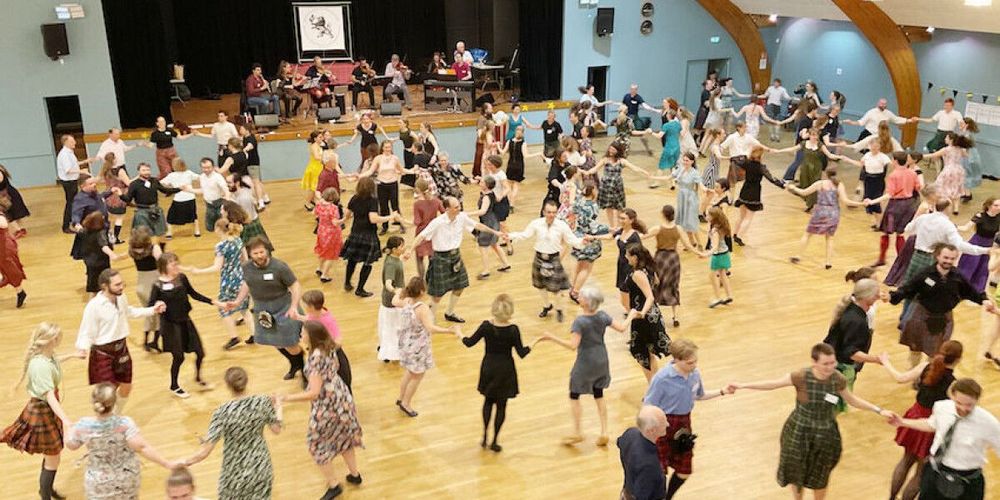
Scottish country dancing thrives in Lyon with mostly French membership
Engineers flock to the Royal Scottish Country Dance Society's Lyon branch, according to dance teacher Laure Gardelle. The appeal lies in the mathematical precision: symmetry of figures, choreographed movements, and rhythm patterns in 4/4 time arranged in series of eight bars.
Yet Gardelle herself is neither scientist nor engineer, but a researcher and English teacher at the University of Grenoble. She discovered Scottish country dancing during a study-abroad programme as a French language assistant at the University of Leeds in 1999-2000. Upon returning to France, she continued with Breton dancing until learning in 2002 that Lyon had its own Scottish country dance association.
A global tradition with local roots
The Lyon branch is affiliated with the Royal Scottish Country Dance Society, which was founded on 28 November 1923 by Mrs Ysobel Stewart of Fasnacloich and Miss Jean Milligan in Glasgow. The organization received its royal designation from King George VI in 1951. Today, the Society comprises 159 branches and over 300 affiliated groups in more than 50 countries across all continents except Antarctica, with 25,000 members worldwide and headquarters in Edinburgh.
Lyon is one of three French branches promoting the dance form, alongside Paris and Brittany. The Lyon branch was established in 1986 through La Chanterelle, an association for traditional dances from around the world. In 1992, two English teachers began offering Scottish country dancing classes every fortnight, later expanding to weekly sessions.
Mathematics meets tradition
Members gather every Friday from 19:00 to 21:00 to practise four different dances and learn the figures for each. Children's classes take place on Mondays. The instruction follows a precise mathematical structure: figures are counted in eight bars, with one dance equalling four sets of eight bars, then position changes and repetitions.
Gardelle has created tutorial videos for the association's website using F.L. Pilling's diagramming system, first published in 1955 in a pocket-sized volume that became known as the 'Little Green Book' among Scottish country dancing enthusiasts. The system employs squares, rectangles, triangles, numbers from two to 32, and letters arranged like equations to explain dances such as The Fisherman's Reel, The Deil Amang The Tailors and Cherrybank Gardens.
Scottish country dancing derives mainly from 17th-century English country dances but incorporates features from older Scottish traditional forms including Strathspeys, Reels, rants and Jigs. The Royal Scottish Country Dance Society has collected dances from living memory and manuscripts dating from the 17th to 19th centuries, republishing them whilst also introducing newly devised dances since the late 1940s.
French enthusiasm for Scottish tradition
Despite Scotland's strong dance traditions and France's own regional styles in Brittany, Alsace and Savoie, the Lyon branch attracts an overwhelmingly French membership. Only one or two members out of every hundred are Scottish. Most members do not speak English, and whilst some developed an interest in Scotland after visiting, the primary draw comes from the atmosphere and sense of community.
Research supports the appeal of the activity's fitness benefits. Studies have shown that 8-12 weeks of dance activity can improve aerobic fitness, muscle strength, endurance and flexibility. A 2014 study by the University of Strathclyde and University of Cumbria found that older women in their 70s who practised Scottish country dancing maintained fitness levels comparable to dancers in their 60s, whilst non-dancers showed age-related decline.
The branch adheres to the federation's credo of fun, fitness and friendship. Members do not participate in competitions or performance events, focusing instead on the practice itself and the social bonds it creates.
Looking ahead
The association completed its 2025-26 season with a mini-ball on 19 June and a barbecue on 27 June. It is already preparing for the next season, with membership remaining remarkably stable.
Very few members have left the association once they joinedGardelle said.
Annual membership including all classes on Mondays and Fridays, two Saturday workshops and federation membership costs €100 for adults, €75 for under-25s and €50 for under-18s. Membership alone costs €37 for adults, €31 for under-25s and €18 for under-18s. All ages are welcome.