Recreation of a missing scene from the Bayeux Tapestry reaches halfway point
A commissioned recreation of the missing final scene from the Bayeux Tapestry has passed its halfway point, with the hand-woven work on track for completion ahead of next year's millennium celebrations marking William the Conqueror's birth.
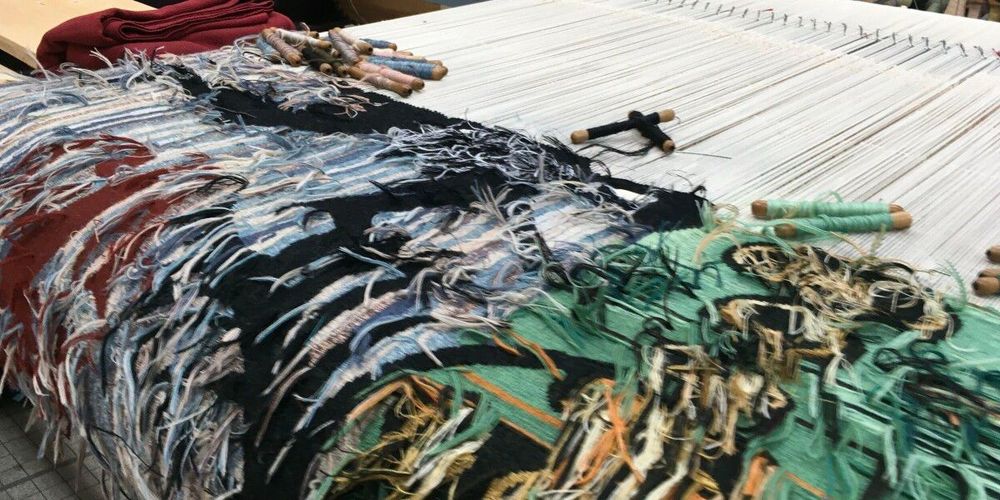
The French region of Normandy commissioned Atelier Tapisserie Guillot, a family-run workshop in Aubusson, Creuse, to complete the 25m² piece depicting the coronation of William at Westminster Abbey in December 1066. Historians estimate that approximately three metres of the original tapestry's ending is missing.
Patrick Guillot, who works alongside his wife Marie and son Luc, reported that the trio has been collaborating on interpreting the missing scene for just over a year. The weaving is done entirely by hand without machines, adhering to traditional methods.
The workshop, founded in 2001, specialises in tapisserie d'Aubusson, a craft inscribed on UNESCO's Representative List of the Intangible Cultural Heritage of Humanity in 2009. This recognition acknowledges the centuries-old weaving techniques practised in Aubusson and surrounding localities in the Creuse region.
Mr Guillot emphasised the importance of using traditional skills and savoir-faire in creating the piece. He noted that while the original Bayeux Tapestry features embroidery on linen using ten colours of woollen thread across nine sewn-together panels, their workshop employs slightly different tapestry techniques. The family's interpretation incorporates linen, silk, bamboo and wool threads in around 100 hand-dyed colour combinations, making it the largest tapestry they have ever undertaken.
The design is based on a sketch by Amiens-born artist Hélène Delprat. While the exact composition will be revealed at the official unveiling in March 2027, it is understood to feature animals, trees and William the Conqueror's white crown. This marks a new chapter in efforts to complete the tapestry's narrative, following a 2014 community project on the Channel Island of Alderney that created a panel showing William's coronation with contributions from over 400 volunteers, including Prince Charles and the Duchess of Cornwall.
International exhibition plans
Following its unveiling, the new scene is planned for exhibition at Westminster Abbey before travelling to the Château de Falaise in Calvados, the birthplace of William the Conqueror. Historians believe William was born between mid-1027 and mid-1028 in Falaise, though the exact date remains uncertain.
Mr Guillot indicated that the completed piece is likely to tour multiple countries, including France, England, Ireland, Denmark, Norway and Italy, as part of broader millennium celebrations.
The region of Normandy has designated 2027 as L'Année européenne des Normands (the Year of the Normans in Europe), with seven European regions participating in the commemorations: the United Kingdom, Ireland, the Channel Islands, Flanders, Southern Italy, Norway and Denmark. A series of thematic events, projects and collaborations are being organised across these territories that share Norman medieval heritage.
Hervé Morin, president of the Normandy Region, stated that a unified approach to promoting cultural and tourism offerings worldwide through joint communication and marketing campaigns would have exceptional impact.
Original tapestry travels to London
The initiative coincides with the loan of the original Bayeux Tapestry to the British Museum from September 2026 until summer 2027. The historic work, which is listed on UNESCO's Memory of the World register, will be displayed in London during a planned two-year closure of the Bayeux Tapestry Museum in Normandy for renovation, with the museum scheduled to reopen in October 2027.
The loan agreement includes a reciprocal cultural exchange, with British Museum treasures including artefacts from Sutton Hoo and the Lewis chess pieces travelling to museums in Normandy.
Up to 80,000 people reportedly joined the British Museum's online queue for tickets when they were released on 1 July, priced at £33 peak and £27 off-peak for adults. The first batch sold out immediately, marking the biggest day of ticket sales in the museum's history. Further tickets will be made available later this year, with prospective visitors encouraged to sign up for email notifications.
The original Bayeux Tapestry measures nearly 70 metres long and 50 centimetres high, weighing nearly 350 kilograms including its cloth and lining. It depicts the events leading up to the Norman Conquest of England in 1066, when William, Duke of Normandy, challenged Harold II, King of England, culminating in the Battle of Hastings and William's subsequent coronation as King of England.